About the Author: Millie Bell studies Spanish and Psychology at the University of Chicago and spends her downtime practicing classical violin, exploring the city with her friends, and scouring the racks of Chicago thrift stores.
The best team of builders will never be able to build a booming city off an unstable foundation, just as a perfectly planned urban jungle will never produce skyscrapers without the help of highly skilled workers. The brain works in the same way: the initial environment a child is born into influences the basis of their functioning brain, and their later experiences build upon that foundation. This foundation is exactly what SitStayRead works to facilitate: providing young children the academic and social skills needed to become confident and motivated readers, exactly when their brains are most ready to receive it. Children require both an initially engaging environment and the dedicated support of their communities if they are to reach full cognitive capabilities later in life. So, how are we as caretakers to facilitate the building of this foundation? In order to discover the answer, it is critical to understand the process of neuroplasticity.
Neuroplasticity is a measure of the brain’s ability to adapt and rework itself in response to its environment. Learning a new skill, navigating a new city from memory, or recovering from traumatic brain injuries all depend on cognitive adaptation. From a physical standpoint, these experiences, and many more, are constantly stimulating neurogenesis (the formation of new brain cells) and a relative strengthening and weakening of neural connections.
While much of fetal development occurs in utero, certain organs continue to mature after birth. One of the best examples of this, of course, is the brain. At birth, a baby’s brain is about 25% of its adult size. By age two, the brain has reached 80% of its eventual size, and up to 90% by age five. During this critical era of development, neuroplasticity is at a peak to facilitate rapid learning. But later interventions, regardless of their vigor, cannot make up for brains hindered by their early environments.
So, all this to say, curating the environment in which a brand new brain grows is imperative to reaching the full potential of a child. Our SitStayRead mission, which builds off this concept, is to create spaces and programs that facilitate learning. We work on how to decode words while fostering motivation, self-regulation, and learning habits during the years when children are most likely to both receive and maintain such skills. This environmental foundation, combined with hard skills practice, provides them a better trajectory for learning with empathy for others and confidence in their own ability to learn even when something is difficult. Heaps of factors can influence this foundation, and this series will tackle several key elements, beginning with learning a second language.
Because neuroplasticity is so high in young children, learning a second language comes most easily from an early age. To tackle a new language as an adult requires explicit and intense memorization of grammatical rules, vocabulary, conjugations, and comprehension, whereas young children gain an implicit and innate understanding of speech patterns and vocabulary through constant immersion. Although parents may shy away from teaching their children their home language in fear that English learning may be compromised, there is no proven correlation. The brain is designed to compartmentalize distinct languages into their own categories, and bilingual children hit speech milestones, like babbling and speaking their first word, at the same rate as monolinguals.
In fact, learning a second language is proven to strengthen cognitive abilities. To be fluent in two languages means constantly thinking and switching between two systems regularly, making brains active and flexible. These skills are invaluable in children: this same flexibility translates into a high capacity for abstract and general thought, aiding in cognitive development which in turn impacts mathematical ability, cognition, logic, focus, memory, and many other associated skills.
Each time a bilingual toddler speaks, the brain must select and suppress relevant languages, strengthening cognitive muscles. The switch between the languages is the difficult part for a child, not learning the language itself. Choosing which language to use in which context uses both empathy skills and executive function skills such as inhibition and task-switching, which impacts both academic performance and socio-emotional learning.
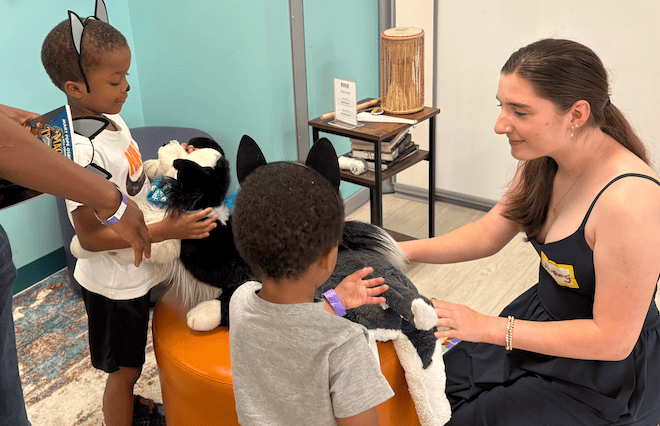
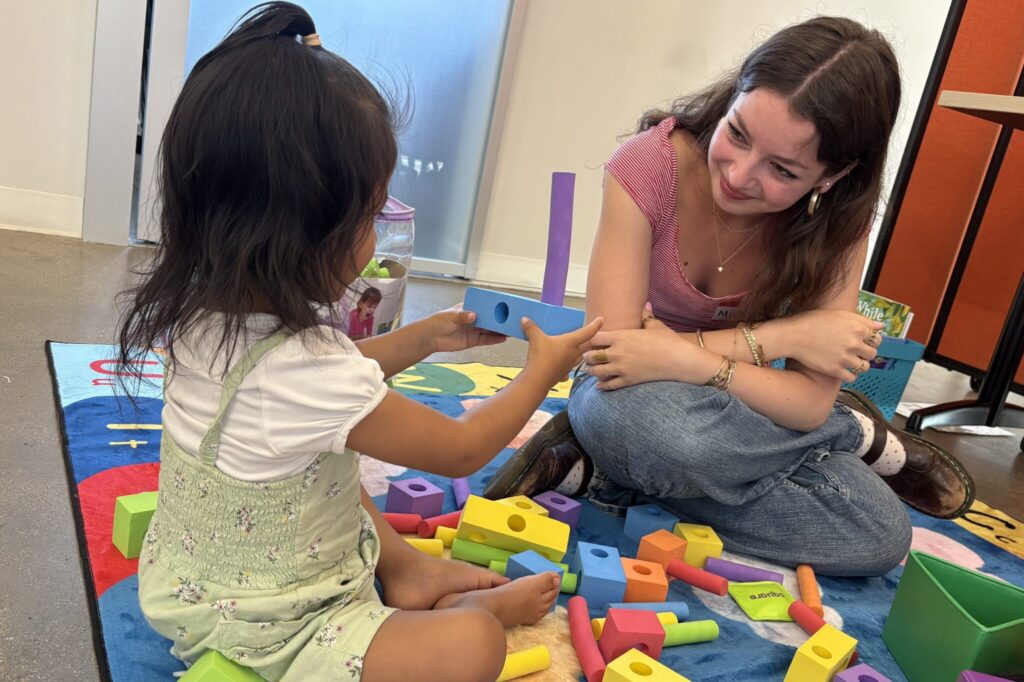
I was able to observe this switch in real time at a recent SitStayRead block party event while chatting with a Spanish-speaking mother and her four year old daughter. When her mother went to check on another of her children, I continued talking to her daughter in my broken Spanish and the child instinctively switched over to English. This seamless switch demonstrated a great amount of social awareness; once her mother had left, she was able to realize that I was more comfortable with English than Spanish and immediately flipped the switch. Given her age, I was in awe that she had the capacity to do so. I felt so fortunate to be able to have witnessed that moment; it served as an undeniable reminder that SitStayRead’s work, beyond supporting literacy, builds this cognitive flexibility and empathy from the ground up and will go on to serve children for decades to come.
All these skills, while important to cull in early childhood, go on to have enormous impact on adult life. Bilingual adults have up to 35% more job opportunities than their monolingual counterparts, and speaking one’s native language helps to maintain a connection with home culture and community.
Although I personally didn’t grow up in a bilingual household, I discovered my own second language early on: music. Inspired by a Sesame Street episode in which Elmo gleefully played the violin, at age three I decided to pick up the instrument myself. Now, 16 years later, I continue in my pursuit of fluency.
Studying music in any capacity from a young age promotes many of the same benefits as growing up bilingual. In the same manner, heightened neuroplasticity makes a new instrument easier to learn as a child, than at any other age, and facilitates the same aforementioned cognitive developments, strengthening academic abilities. Though it is nearly impossible to attribute my own mental skills specifically to music, I have found that language learning and math come fairly naturally to me, and growing up on a stage gave me an unique and invaluable set of social skills that I indubitably would never have learned without music.
When I first started learning violin, it was a very routine procedure: Thursday afternoons were private lessons, Mondays were group lessons, and every day in between was for practice. My early studies taught me that my work had traceable, direct results, a motivation tactic that I still rely on today. My parents treated violin practice like any other daily routine, building it in with brushing my teeth and bathtime. I learned to expect, and later love, this habit. Although I am positive that I owe much of my socioemotional evolution to my music study, it is difficult to trace specific connections in myself; I turned to my parents for more accurate observation. They noted that beyond the obvious benefit of having built-in Thanksgiving dinner entertainment, it also undoubtedly shaped who I was as a person.
Ultimately, the way in which the brain is shaped matters much less than the fact that it is being shaped. Bilingualism and music are great ways to facilitate cognitive development, like reading, but the significance lies in giving young brains rich material that provides a solid groundwork for the rest of their lives. This is what SitStayRead fights to provide: the building of this neural foundation.
SOURCES:
- Dana Suskind: Thirty Million Words
- https://www.ed.gov/media/document/bilingual-enpdf-99175.pdf
- https://www.cambridge.org/core/journals/bilingualism-language-and-cognition/article/abs/development-of-two-types-of-inhibitory-control-in-monolingual-and-bilingual-children/303430BA7FA8296F32DFD02FD48E8721
- https://www.canr.msu.edu/news/advantages_of_a_bilingual_brain
- https://www.kqed.org/mindshift/47054/whats-going-on-inside-the-brain-of-a-bilingual-child
- https://www.firstthingsfirst.org/early-childhood-matters/brain-development/