About the Author: Avery Lakomy, a student of Notre Dame ‘30, a self-professed book nerd, and aspiring marine biologist, served as a RISE Hometown Summer Intern with SitStayRead in 2026.
SitStayRead’s learning enrichment model uses evidence-based approaches, including the human-canine bond to boost youth engagement and performance in education and community settings citywide. Their in and out of school programs foster academic achievement and reinforce social-emotional regulation—a pawsome addition to K-2 literacy instruction provided by teachers and dedicated specialists throughout the school year. Coregulation, a mutual process of establishing connection, can help calm a child’s nervous system, manage big emotions, and contribute to constructing a safe environment for learning and practicing new literacy skills. This biological and emotional foundation on which children can build stronger self-regulation while participating in relationships with other living beings.
Is That a Dog in an Elementary Classroom?
Plip-flop, pitter-patter. Unfamiliar noises echoing down an elementary school hallway might cause one to momentarily pause outside a Chicago Public School elementary classroom door. Could that be—no, surely not. The sounds of pawsteps?
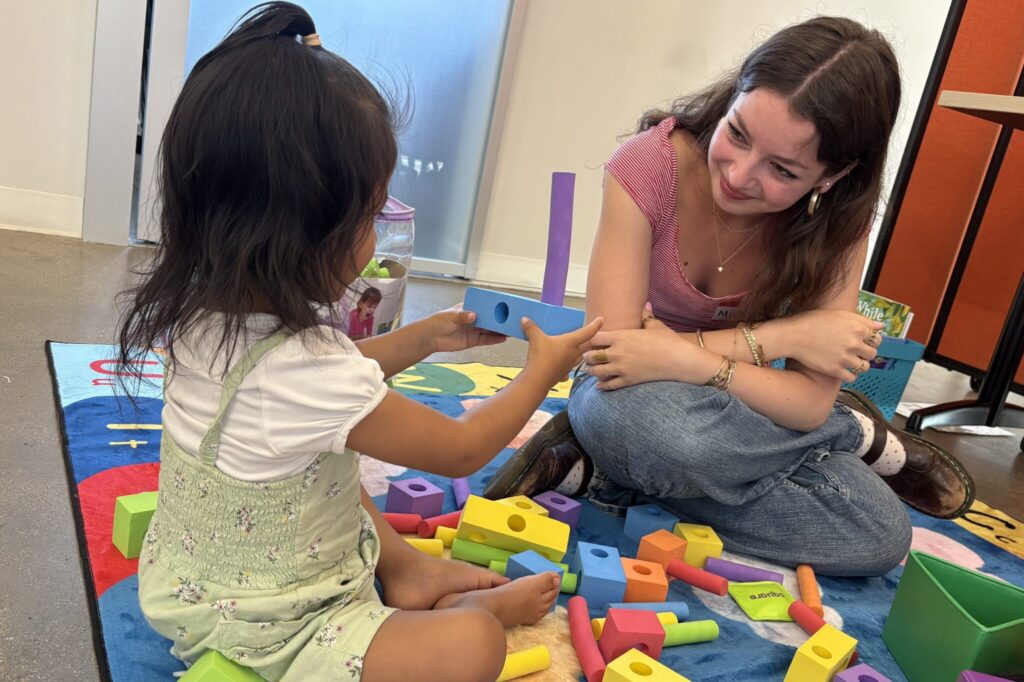
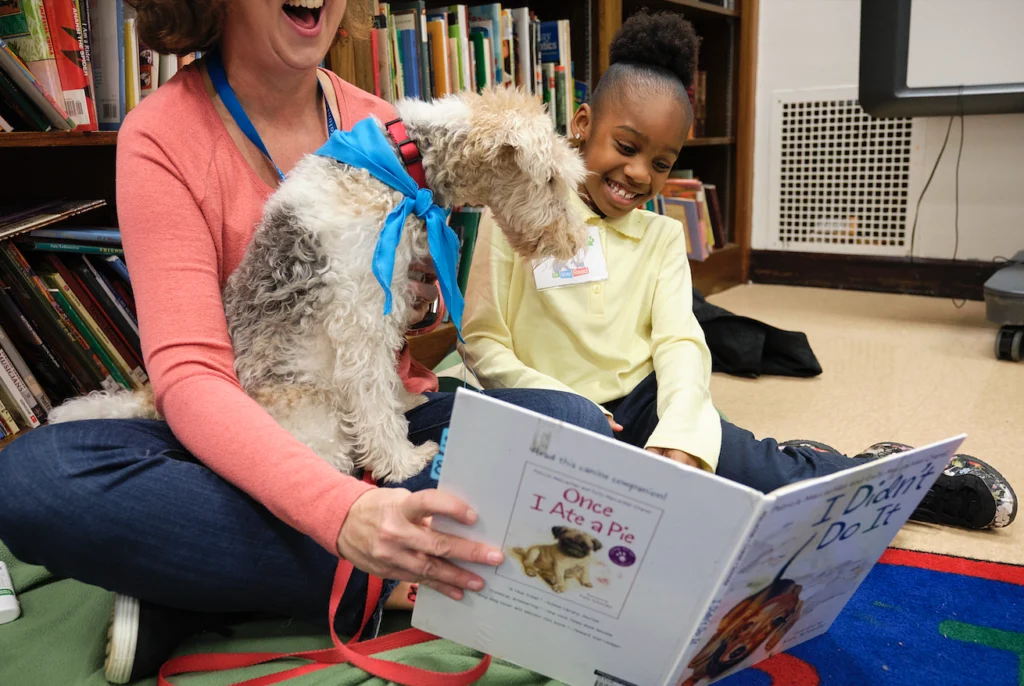
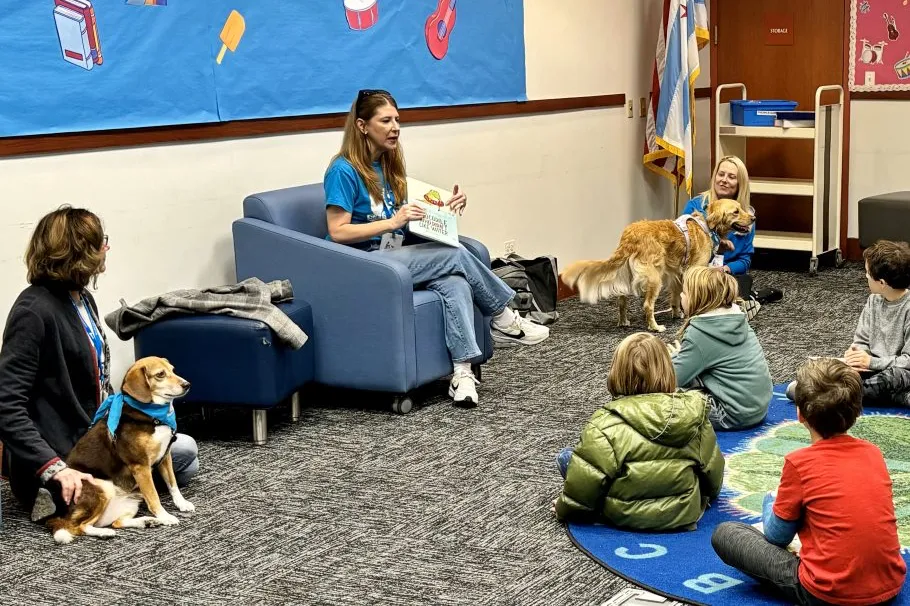
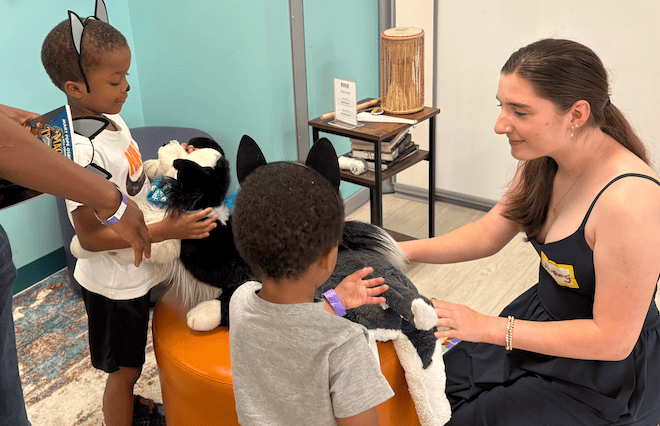
You do a double-take to survey the familiar classroom, and your eyes land on a group of students gathered on the carpet. Giggling, one practices gently petting a blanketed, stuffed dog while another flips through a vibrant picture book while reading the unfolding story to…an actual, real-life dog?! This dog wears a blue bandana identifying it as a SitStayRead Certified Reading Assistance Dog. She attentively listens to these young readers, enjoying lots of pets and acting as a social companion in this tight-knit, focused reading circle facilitated by her owner and Dog Team Handler, who is also a trained, volunteer Book Buddy.
Although quiet and calm on the outside, maybe even snoozing, this dog is secretly a cheerleader for anyone brave enough to open that picture book and sound-out the words inside it, sound by sound, syllable-by-syllable, word by word, sentence by sentence. Having a companion who is a master of listening and never interrupts is a big help. For some children, the prospect of reading can incite impending doom – learning to read and reading out loud can be scary! But with the dog’s pawsitive, encouraging presence – a few friendly moments of eye contact, tail wags, and nose kisses – reading can feel much less overwhelming, which in turn paves the way for showing up, trying, and learning more with a sense of wellbeing.
How Do Human-Canine Interactions Foster Literacy Benefits?
In recent years, the presence of human-animal interactions (HAI) as a creative learning tool and developing focus for researchers, anthrozoologists, has increased in educational and community settings, in tandem with innovative learning enrichment strategies. Community-based partners including Enlace Chicago and VOCEL, have begun incorporating HAI into family programming by inviting SitStayRead in as a summer partner.
The expansion of HAI programs nationwide raises a central question among educators, administrators, and families alike: what is the pedagogical value of this innovative education model in elementary classrooms? How do HAI enhance academic and social emotional learning in early grades, strengthening cognitive development and scholastic achievement.
At SitStayRead, we believe the child-canine bond is a useful support in teaching and learning, and fosters a sense of youth agency. We aim to strengthen the cognitive gap between classroom instruction and a child’s internal language processing—with the long-term goal of equipping students with lifelong literacy skills and a love of learning, all with the support of Certified Reading Assistance Dogs. Researchers attribute K-9 classroom presence to supporting the process of establishing foundational literacy skills and amplifying social-emotional intelligence in children—all of which prepares students as learners and community members.
How Does Literacy Unleash a ‘Domino’ of Holistic Welfare Outcomes?
According to the National Library of Medicine (NLM), an estimated 796 million people (15 percent of the global population) are unable to read—which frames literacy as an entirely normal and an indiscriminate challenge, affecting members of all communities. Substantiated by the United Nations Educational, Scientific and Cultural Organization (UNESCO), approximately 739 million adults (ages 15 and above) and 99 million youth (ages 15-24) are unable to perform basic literacy skills, such as the ability to read, write, and understand simple sentences.
Limited literacy is associated with poor physical and mental health outcomes, including diminished self-esteem and social participation, concurrently with a higher probability of accidents and job absenteeism. In the primary (K-2) education system, moreover, a child’s literacy skills can predict their academic performance in all subject areas and observed reading attitude, as well as perceived learning enjoyment.
Among many complex education barriers, youth literacy is impacted by “chronic absenteeism,” which the United States Department of Education (USDE) defines as missing 10% or more of the school year, without a valid excuse for absence. According to data collected during the 2024-25 school year, 25% of Illinois public school students are chronically absent—3% higher than the national average—with disproportionate impacts on learning in low-income neighborhoods.
Among correlations, these concerning statistics reflect the impact of the COVID-19 pandemic on the U.S. education system, as explained by the USDE, including students’ struggles with their physical and social-emotional health amid pandemic-induced isolation. While public school attendance has increased in recent years in some areas, it continues to remain lower than pre-pandemic years because of student and parent disengagement. The University of California Los Angeles attributes academic withdrawal to chronic physical and mental health struggles, associated with hostile school environments and academic demotivation.
Creative education models designed to increase school enjoyment, motivation, and engagement are valuable assets for our schools. The human-canine bond is capable of maintaining and increasing student attendance in schools. In fact, SitStayRead’s non-profit partners report K-2nd grade attendance is good or improves on “dog days” during a two-month residency period. Researchers through the NLM and National Institute of Health assess the human-canine bond as an evidence-based HAI that can foster a welcoming learning environment, foundational literacy skills, and cognitive development for primary school students unparalleled by alternative and more traditional learning models.
Child-Canine Synchrony
While sitting in the calming presence of a dog, one may naturally feel like the best version of ourselves—and it’s scientifically proven! Researchers reveal that a dog’s presence “may have a beneficial effect on a number of [our] behavioral processes,” encouraging our bodies to self-regulate independently of our environment. Self-regulation directed through the human-canine relationship is extremely beneficial during situations where we desire peace of mind and control over our body, yet struggle to reach it. It allows us to accomplish the seemingly impossible, such as calming ourselves in an anxious state or honing our attention amid a chaotic environment.
But we’re not the only ones affected during this process since it’s co-regulatory, mutual physiological and emotional regulation.
For instance, let’s use reading anxiety and low motivation in the classroom as a co-regulation example because this is a key focus of SitStayRead’s mission. Reading anxiety and low motivation in classroom settings are often attributed as consequences of “classical conditioning” or behaviors acquired over time due to repeated stimuli, such as “teacher judgment or peer ridicule” experienced as the result of reading. However, the quiet presence of a certified reading assistance dog (including a SitStayRead Reading Buddy) is able to mitigate these effects through co-regulation.
Beside a human Book Buddy/Dog Team Handler as well, canine-human physiological synchrony allows a young reader’s blood pressure and heart rate to naturally match that of the dog’s—effectively triggering a relaxation response in their body, mirroring the dog’s hemodynamic stability pertaining to their heart rate and blood pressure, as well as their calm emotional state. Researchers recognize this biological cascade as a two-way street—induced by humans and dogs on one another: mutual autonomic nervous system co-modulation (physiological synchronization) and co-regulation (calmed emotional state). Researchers hypothesize that human-canine synchrony is triggered by a mutual release of oxytocin—a neurotransmitter that causes relaxation—in the brain during human-canine interaction. What can simply be described as “two hearts beating as one” is entirely scientifically accurate.
Counterconditioning with canine-assisted learning also encourages children to cultivate cognitive awareness, or in other words, develop awareness for their emotional feelings and social interactions. These cognitive skills are crucial for raising active and compassionate community members, who have the tools to self-regulate big emotions and form genuine connections with peers—all of which can be supported through the child-canine bond. Children who read with Certified Reading Assistance Dogs are likely to exceed their peers in cognitive maturity due to these benefits, according to researchers.
By fostering a welcoming environment through physical synchronization and a calm emotional state, SitStayRead sets the stage for young students to form a positive association with reading and countercondition any stress or anxiety subconsciously associated with language learning, allowing them to effectively build literacy through intellectual growth and emerge as lifelong learners.
Sources:
- Deborah Summers. (2025). Let reluctant readers go to the dogs. In Literacyworldwide.org. https://www.literacyworldwide.org/blog/literacy-now/2014/07/22/let-reluctant-readers-go-to-the-dogs-
- Dr. Leslie Korn. (2025). A healing bond: How Dog-Human synchrony enhances Co-Regulation | Dr. Leslie Korn. In Dr. Leslie Korn. https://drlesliekorn.com/research/dog-human-synchrony-mental-health/
- Hall, S. S., Gee, N. R., & Mills, D. S. (2016). Children reading to Dogs: A systematic review of the literature. PLOS One, 11(2), e0149759. https://doi.org/10.1371/journal.pone.0149759
- Hickam, O. (2025). 1-in-4 Illinois students absent in 2025. In Illinois Policy. https://www.illinoispolicy.org/1-in-4-illinois-students-absent-in-2025/
- Kane, K. (2016, May 9). new study proves that dog and human hearts beat together. The Rover Blog. https://www.rover.com/blog/new-study-proves-dog-and-human-hearts-beat-together/
- Research. (n.d.). In HABRI. Retrieved July 28, 2026, from https://habri.org/research/
- Santibañez, Ph.D., L. (2024). Rebuilding More Humane Schools Post-COVID-19: Prioritizing Student Engagement, Social-Emotional Learning and Well-Being – UCLA Center for the Transformation of Schools. In UCLA Center for the Transformation of Schools – UCLA Center for the Transformation of Schools. https://transformschools.ucla.edu/research/rebuilding-more-humane-schools-post-covid-19-prioritizing-student-engagement-social-emotional-learning-and-well-being/
- Sean Nealon. (2021). Dogs synchronize their behavior with children, but not as much as with adults, study finds | newsroom. In Newsroom. https://news.oregonstate.edu/news/dogs-synchronize-their-behavior-children-not-much-adults-study-finds
- Therapy dog types: Understanding the difference – UDS foundation. (2023). In UDS Foundation. https://udservices.org/therapy-dog-types-understanding-the-difference/
- U.S. Department of Education. (2025). Chronic absenteeism. In U.S. Department of Education. https://www.ed.gov/teaching-and-administration/supporting-students/chronic-absenteeism